 MOGA World
AI Automation for a Small Online Business: What to Automate First and What to Leave Alone
AI automation for a small online business is not a robot answering customer mails. Your week looks different. It has a stock check, a supplier you keep meaning to chase, a discount you are unsure about, and the same two hours of admin every Monday. This article is about that part: what AI automation means for a small online business, which jobs to hand over first, which four to keep, and how to work out in five minutes whether a job is worth it.
What AI automation means for a small online business
AI automation for a small online business means letting an AI assistant do the repeatable reading and writing of your week, such as checking stock against your own rules or drafting a reply, while you approve anything that costs money or goes out in your name. It is not a robot that runs the business. It is the typing and the checking, done for you, with your decision kept.
Want a second pair of eyes first?
The free site check reads up to 4 pages of your business website and returns up to 6 things to fix, each marked do, skip or ask. Free, no account, results in about a minute.
There are two things people mean by “automation”, and mixing them up is where most disappointment starts. A rule based tool, such as Zapier or Make, does exactly what you wired: when X happens, do Y. It never guesses, and it breaks when the input is not what it expected. An AI assistant handles messy input, like a customer mail, a supplier message or a spreadsheet that changed shape, but it can be confidently wrong. That is why a good setup ends every job with a draft or a card for you to check, not an action.
Three kinds of automation, and where each fits
Use a rule based tool for exact moves, an AI chat for one off writing, and an AI that reads your files and a board for the weekly jobs that need judgement.
| Kind | Good for | Watch out for |
|---|---|---|
| Rule based tool | Exact, repeated moves: a new order adds a row to a sheet, a tag triggers a mail | It cannot read a message or judge a number. Every exception is a rule you must write |
| AI chat | One off writing and thinking: a product text, a reply, a summary | It forgets your business between chats unless you paste it in again |
| AI that reads your files and a task board | Weekly operating jobs: stock, suppliers, customer mails, what slipped | Takes a setup session, and you must open it a few times a week |
The third row is what I build at MOGA, using Claude Code. That is Claude, the AI assistant from Anthropic, working inside VS Code, a free editor app, so you chat with it in a window and it can read the files in one folder. A Trello board (a free task board) holds the weekly jobs, a folder holds your business rules, and Claude reads both every session. MOGA World is independent and not affiliated with Anthropic. If you are weighing Claude against the chat app you already pay for, Claude vs ChatGPT for running an online business compares them job by job.
Which AI automation job to hand over first: the hours test
Pick the job that repeats every week, follows a rule you can write down, and where a wrong answer is caught before it costs money. If a job fails any of those three, it is not the first one. Then do the arithmetic, because “it feels slow” is not a number.
Here is an example with invented numbers for a one person business:
| Weekly job | Minutes a week | Hours a year |
|---|---|---|
| Stock check on the 10 best sellers | 45 | 39 |
| Chasing late supplier orders | 20 | 17 |
| First drafts of customer replies (15 minutes a day, 5 days) | 75 | 65 |
| Total | 140 | 121 |
At EUR 25 for an hour of your time, 121 hours is about EUR 3,000 a year. You will not get all of it back: you still read every draft and every card. Say you keep a third of the time for approving. That leaves you about 81 hours back, worth about EUR 2,000. Against that, Claude Pro costs about EUR 18 a month before VAT, so EUR 216 a year, plus a setup session once. Change the three numbers to your own. If your total is under an hour a week, leave it alone for now.
Three jobs that hand over well first
1. The Monday stock check
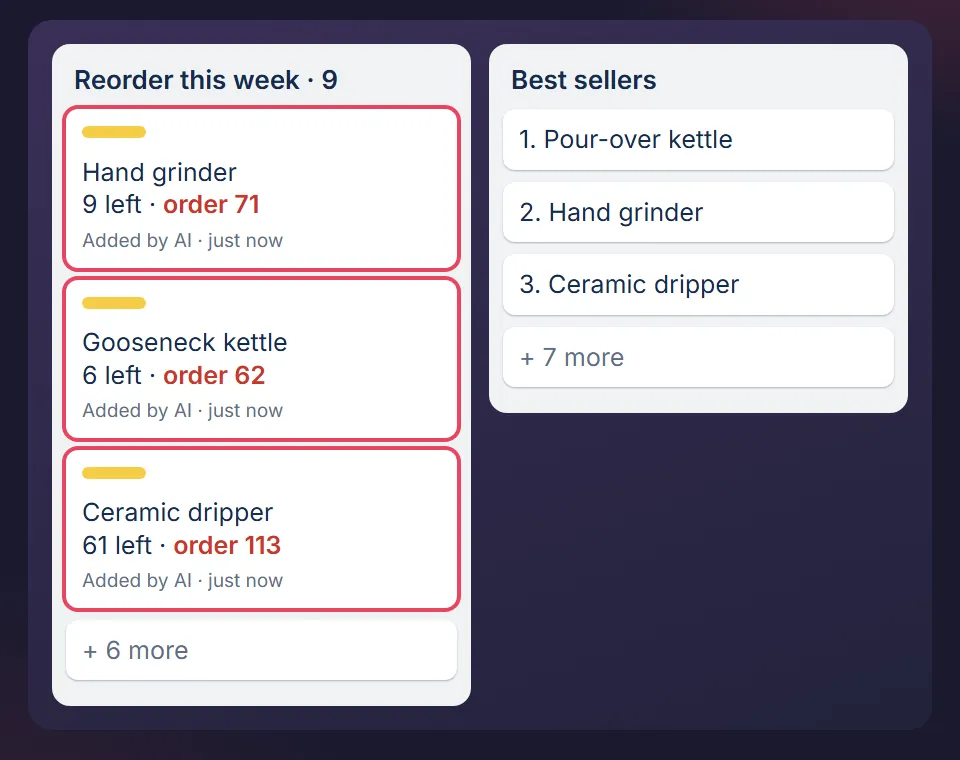
Claude reads your sellable stock and how long each supplier really took on the last three deliveries, then adds one card for every product that will run out before the next delivery can arrive. It suggests a quantity and never orders.

2. The supplier chase
Claude lists the orders that are past their due date and drafts one short chase mail for each. You send it or decide to wait.
3. First drafts of customer replies
Claude reads the customer's message and your written rules, such as your returns window and what you refund, then drafts a reply. Nothing goes out in your name until you press send.
The detailed walkthrough of these jobs, plus two more, is in Claude for a small business: the 5 jobs it takes off a seller. The procedures behind them are in the 6 procedures to write first.
Four jobs to keep with you
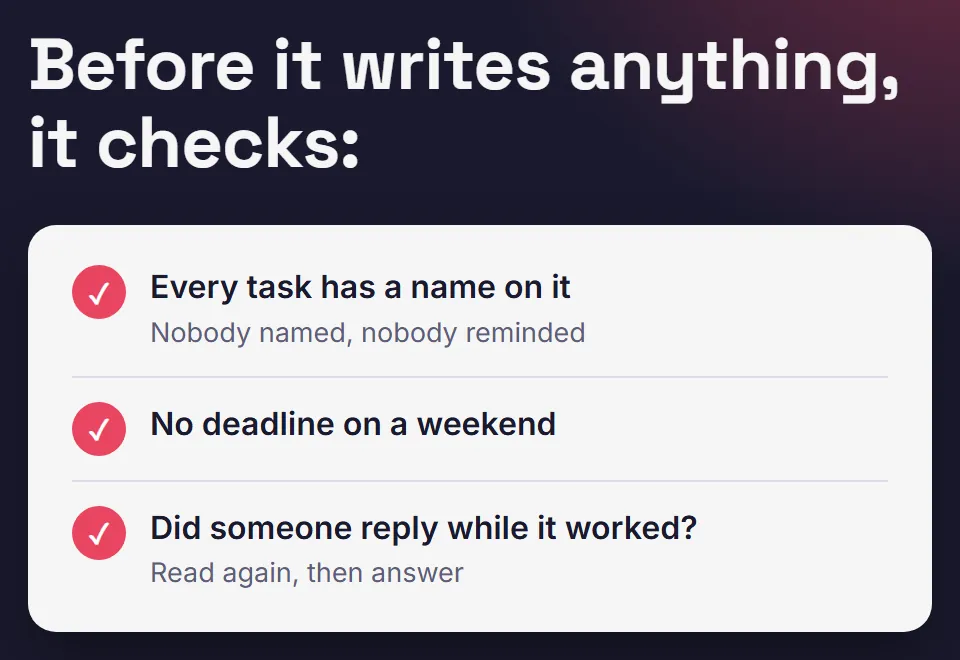
Keep every job where a mistake is expensive, hard to undo, or needs knowing a person. That means four things stay yours, whatever the tool can technically do:
- Changing a price. A discount approved on a margin that forgot the marketplace fee is the classic expensive mistake. Let the assistant check the margin and put the answer in front of you. The change waits for your Go.
- Moving money. Paying a supplier, placing an order, issuing a refund. Anything that spends.
- A customer who is already angry. A draft is fine as a starting point, but this one is read slowly and sent by you.
- Choosing what to sell. An assistant can read your sales. It cannot know what you want the business to become.
There is one habit worth copying even if you build all of this yourself. When a rule gets broken twice, turn it into a check that runs before anything goes out. You stop relying on remembering.
More on where the line sits: will Claude Code change prices or send mail without asking.
What AI automation costs for a small business
The running cost is about EUR 18 a month, and the one off cost is a two hour setup, or EUR 129 for the ready made Decision Page. The list:
- A Claude plan that includes Claude Code. Claude Pro is about EUR 18 a month before VAT, paid to Anthropic.
- VS Code, a free editor app, and a free Trello account.
- An access code (an API key) from your sales platform, such as Shopify, WooCommerce, Etsy, Amazon or bol.com. It lets the assistant read your stock and orders, and nothing connects until you create it.
- Setup with the MOGA workspace takes about two hours, once. The ready made Decision Page is EUR 129, one payment. If you want it set up for you, the install is EUR 399 fixed.
Not sure whether you need a person or a template? Ecommerce consultant or template works through it with the arithmetic.
Questions people ask
Do I need to code to automate with AI?
No, you describe jobs in plain words. Claude Code runs as a chat window inside a free editor app. Do I need to code to use Claude Code has the details.
Does it run by itself while I sleep?
No. It reads and drafts when you open it. A check for overdue cards does run by itself every day, but it only flags, it does not act. If you will not open it twice a week, no setup will help.
Is AI automation worth it for a business of one person?
It pays when the jobs you repeat add up to more than about an hour a week, and the arithmetic above is how you check. Under that, a printed checklist does the same job for free.
What can go wrong?
The main risk is a confident wrong answer. That is why every job ends with a draft, a card or a row for you to approve, and why price changes and sending money are on the keep list.
Start free, then decide
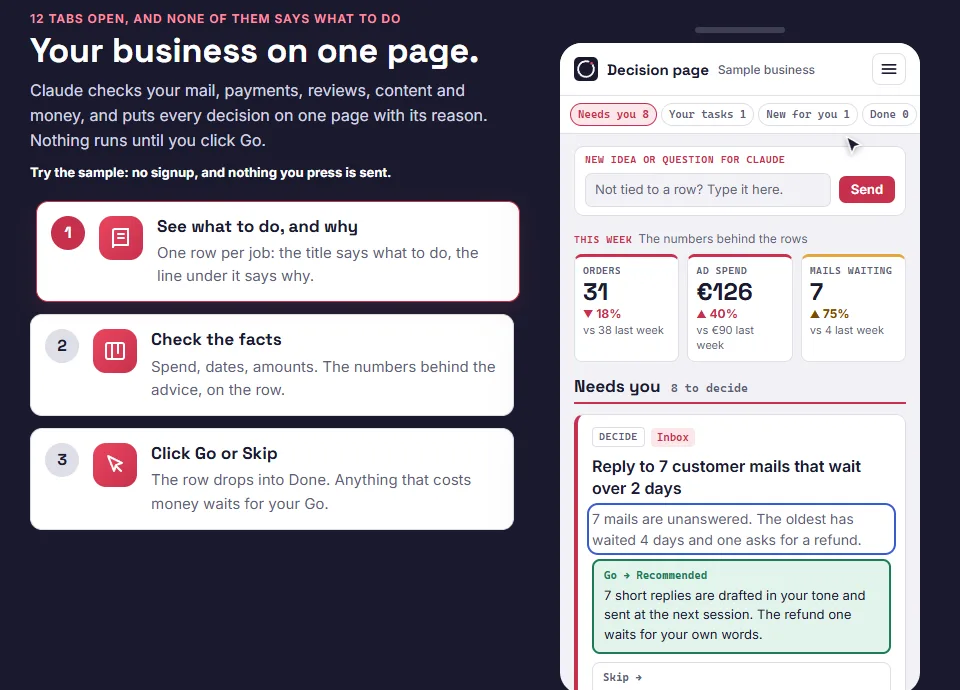
The quickest way to see if this fits your week is the free sample page: one page of decisions with sample data, nothing sent, no signup. If you would rather start from your own website, run the free site check.
Or check your website for free, see the packs and prices, or book the free intro call and tell me which job eats your week.
Read next: Claude for a small business, one Trello board for stock, supplier orders and returns, which Claude Code skills are worth making, the 6 procedures to write first, or what an AI automation service should include.
MOGA World is independent and not affiliated with Anthropic or Atlassian. Sample businesses and the hours example in this article are invented. Questions: stef@mogaworld.co