 MOGA World
Weekly Planner Template for Sellers: the 5 Check Business Review
A weekly business review template is a 30 minute Monday routine with five checks on last week: sales, margin, stock cover, open problems and cash. Each check has one number to read and one line that says when to act. A planner then takes five more minutes: three lines for the week ahead.
Most weekly planner templates start with the blank week: seven columns and nothing to put in them. That is the wrong end. You plan better after you have looked at what happened, and a small online business only needs five things to look at. This article gives you the five, the rule for each, and one worked week with numbers.
Short on time? The free sample page shows one such check as a decision, with its reason, and you approve before anything changes: See the free sample page
A review reads last week, a planner schedules next week
A planner lists what you intend to do. A review tells you what actually happened, so the intention is based on something. Done in that order the whole thing fits in 35 minutes: 30 for the review, 5 for the plan. Done the other way round, the planner fills with tasks that last week already made irrelevant, such as a price change when the real problem is a stockout.
It works for one person or a small team selling on Amazon, Etsy, bol or your own webstore, and runs from numbers you already have in your store admin, your marketplace dashboard and your bank.
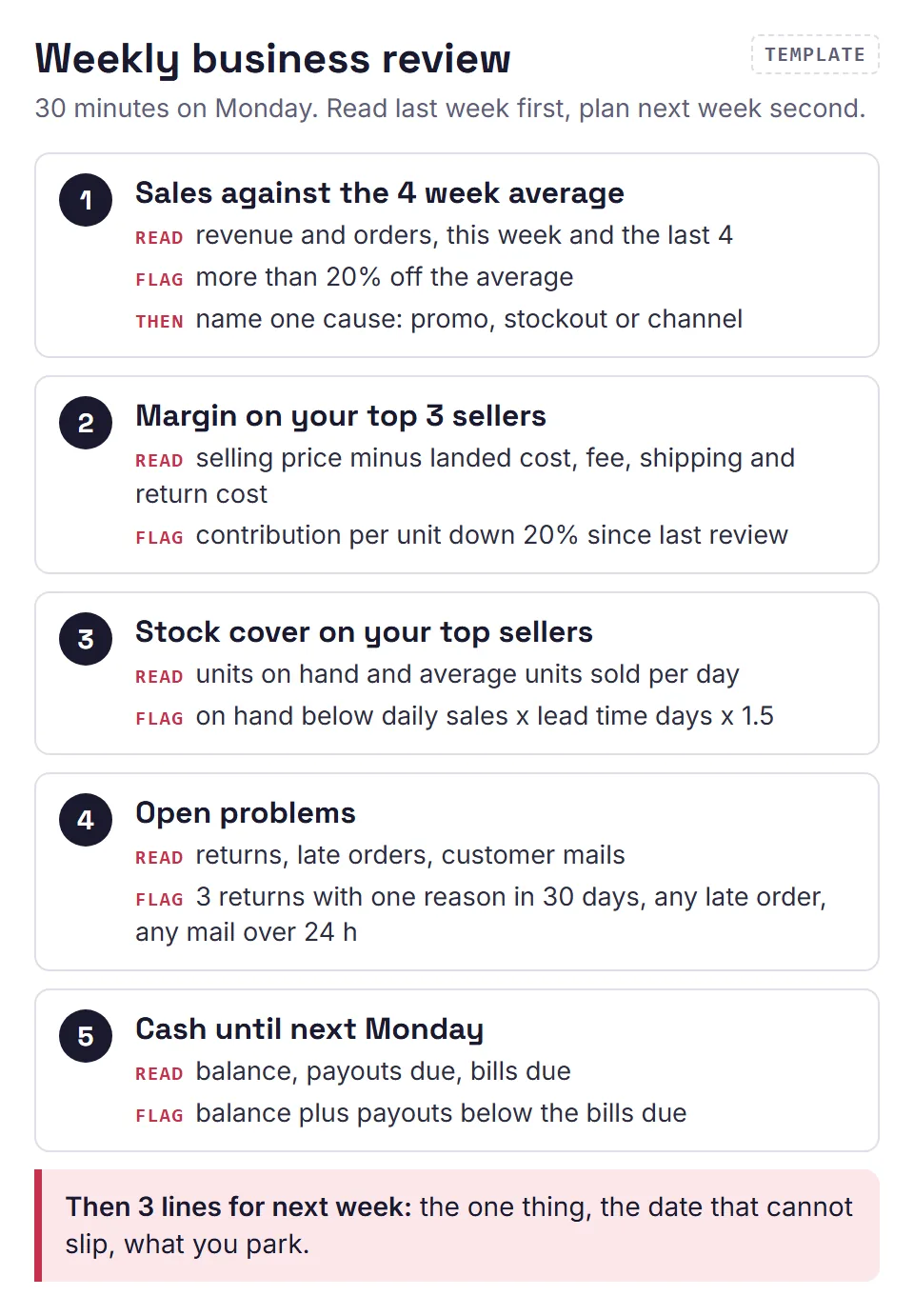
The 5 checks
The thresholds below are starting points. Keep them for four weeks, then replace each with a number from your own history.
1. Sales against the 4 week average
- Read: revenue and order count for the week, and the average of the 4 weeks before it.
- Flag when: the week is more than 20 percent off the average, up or down.
- Then: name one cause before you do anything else: a promotion, a stockout, a channel that changed. A drop with no cause you can name is the one to chase.
Compare against the 4 week average, not last week. One quiet week is noise, and a comparison with a single week makes every week look like news.
2. Margin on your top 3 sellers
- Read: contribution per unit = selling price minus landed cost minus marketplace fee minus shipping minus (return rate × cost of a return).
- Flag when: contribution per unit has fallen more than 20 percent since the last review, and today if it is negative.
- Why it is in the review: sales can rise in the same week margin halves. Freight, fees and returns move without telling you, and the price on the listing does not.
The full version of this rule, with a sample calculation, is procedure 6 in the ecommerce SOP template.
3. Stock cover on your top sellers
- Read: units on hand, and the average units sold per day over the last 4 weeks.
- Flag when: units on hand are below daily sales × supplier lead time in days × 1.5.
- The trap: 150 units at 6 a day is 25 days of cover, which looks safe against a 21 day lead time. It is not. Deliveries run late, so the rule asks for 31.5 days, which is 189 units. Order at 189, not when the shelf looks empty.
Use the last three real lead times, not the one the supplier quoted. Damaged or reserved units do not count as stock.
4. Open problems
- Read: returns from the last 30 days with their stated reason, orders that shipped late or not at all, and customer mails older than 24 hours.
- Flag when: 3 or more returns have the same reason within 30 days, or any order is late, or any mail has waited more than 24 hours.
- Then: one card per pattern, never one per return. A repeat reason nearly always points at a listing that is wrong (size, colour, quantity), not at the product.
5. Cash until next Monday
- Read: the balance you can spend today, the payouts that land before next Monday, and the bills and supplier payments due before then.
- Flag when: balance plus payouts is lower than the payments due.
- Why last: checks 1 to 4 usually decide what you are about to spend. Cash tells you whether you can.
If a check shows nothing, write “clear” next to it. A blank line cannot be told apart from a check you skipped.
A weekly business review example
The business below is invented, with three products. It is one real shape of week: three flags and two clear.
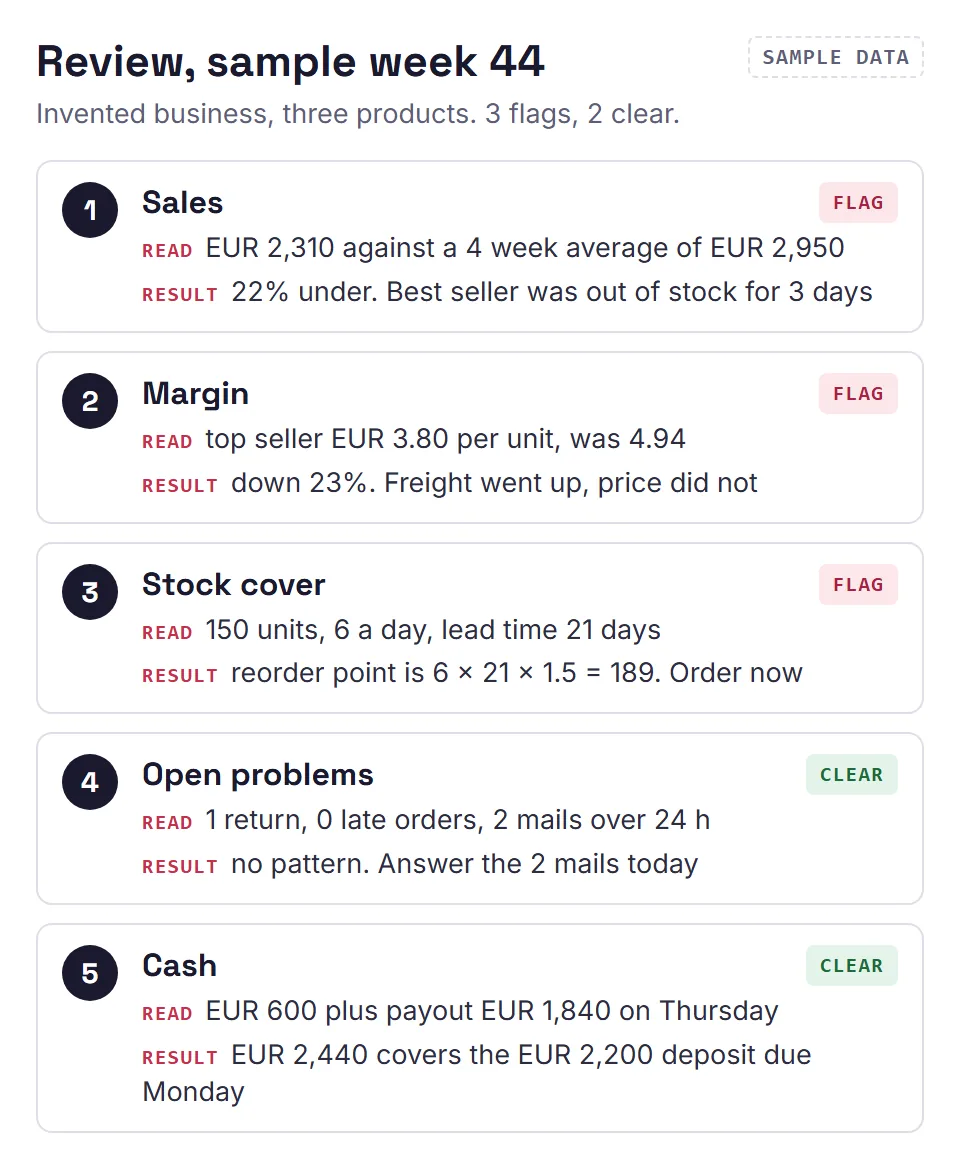
Read the three flags together and they tell one story. The stockout in check 3 explains the sales drop in check 1, and the reorder it calls for is the EUR 2,200 deposit that check 5 confirms you can pay. Five separate numbers became one decision. That is what a review is for, and no planner column would have shown you.
The planner half: three lines for next week
Once the five checks are written, the plan is short, because the review already chose it. Three lines are enough:
- The one thing: the action from the check that costs most if you skip it.
- The date that cannot slip: a supplier payment, a delivery, a deadline.
- What you park: one job you will not touch this week, and why.
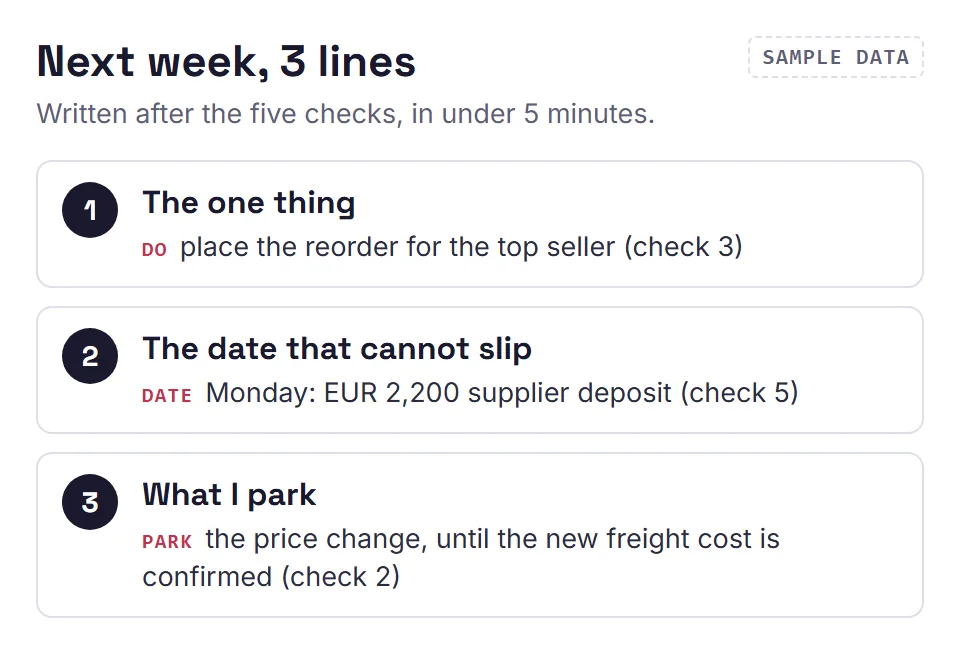
The third line is the one people skip, and the one that keeps the week small. In the sample, the price change is parked because check 2 says margin fell for a cause you have not yet priced in.
Where the review lives so it gets done
- Same slot every week. Monday morning works because the weekend orders are in and the week is not yet running you.
- A repeating card with a due date. A review in a folder gets done twice. A card that comes back on its day gets done. The same rule is behind the board in this Trello workflow article.
- A time limit in the title. “Weekly review, 30 min max”. A routine stays weekly when you can see it is small.
What you need
- Read access to your orders, your marketplace payouts and your bank balance. Nothing to install.
- One sitting to find where each number lives. The first review takes about an hour for that reason, and it is fine to run checks 1 and 3 on the weeks you have if you do not yet have four. After that the review is reading, not searching, and 30 minutes is realistic.
- Claude is optional. It can read the same numbers and write the five lines for you, and you still decide. This article shows how.
Where it stops
- A review shows what happened, not what to sell. It checks the business you already run.
- The thresholds are samples. A 20 percent line is wrong for a business with spiky sales, so replace it after a month of your own numbers.
- If you do not do it on a fixed day, it will not happen, and no template fixes that.
How I use it
I spent six years running ecommerce businesses. The rules above were each written after something went wrong, then rebuilt as a clean template with invented sample data, so nothing from those businesses is in it. How I run MOGA with the same method is on How MOGA is run.
See one check as a decision, free
The free sample page shows the stock check from this article as one decision, with its reason, and you approve before anything changes. No signup, and nothing you press is sent. The free starter board, the Trello version in the same format as the paid boards, is the email step behind it.

Optional, after the sample page: the free starter board is the Trello version: one board with sample data. You do not need Claude to use it. Leave your email and the board link comes by email.
Want the weekly routine already built? It is in the packs.
MOGA World is independent and not affiliated with Anthropic or Atlassian. Sample businesses and numbers in this article are invented. Questions: stef@mogaworld.co